Monday, March 9, 2009

KEITH JARRETT

Download Music!: Keith Jareet-Body And Soul; Keith Jarrett-My Song; Keith Jarrett-For Yawuh

Keith Jarrett (born May 8, 1945 in Allentown, Pennsylvania) is an American pianist, composer and jazz icon.

His career started with Art Blakey, Charles Lloyd and Miles Davis. Since the early 1970s he has enjoyed a great deal of success in both classical music and jazz, as a group leader and a solo performer. His improvisation technique combines not only jazz, but also other forms of music, especially classical, gospel, blues and ethnic folk music.

In 2003 he received the Polar Music Prize, being the first (and to this day only) recipient not sharing the prize with anyone else.

Early years

Jarrett grew up in suburban Allentown, Pennsylvania with a significant exposure to music. He displayed prodigious talents as a young child and possessed absolute pitch or perfect pitch. He played his first formal public concert to paying customers at the age of six and it ended with two of his own compositions. He took intensive classical lessons, and particularly enjoyed playing compositions by Bartok. In his teens, as a student at Emmaus High School, he learned jazz and quickly became proficient in it. At one point, he had an offer to study composition with the legendary Nadia Boulanger in Paris; this was amiably turned down by Jarrett and his mother. In his early teens, he developed a stronger interest in the contemporary jazz scene: he recalls a Dave Brubeck show as an early inspiration.

Following his graduation from Emmaus High School in 1963, Jarrett moved from Allentown to Boston, Massachusetts, where he attended the Berklee College of Music and played cocktail piano. Jarrett then moved to New York City, where he played at the renowned Village Vanguard club.

In New York, Art Blakey hired him to play with his Jazz Messengers band, and he subsequently became a member of the Charles Lloyd Quartet (a group which included Jack DeJohnette, a frequent musical partner throughout Jarrett's career). The Lloyd quartet's 1966 album Forest Flower was one of the most successful jazz recordings of the late 1960s. Jarrett also started to record as a leader at this time, in a trio with Charlie Haden and Paul Motian. Jarrett's first album as a leader, Life Between The Exit Signs (1967), appeared around this time on the Vortex label, to be followed by Restoration Ruin (1968), which is easily the most bizarre entry in the Jarrett catalog. Not only does Jarrett barely touch the piano, he plays all the other instruments on what is essentially a folk-rock album, and even does all the singing. Another trio album with Haden and Motian followed later in 1968, this one recorded live for the Atlantic label and called Somewhere Before.

Miles Davis

When the Charles Lloyd quartet came to an end, Jarrett was asked to join the Miles Davis group after Miles heard Jarrett in a New York City club. During his tenure with Davis, he played both Fender Contempo electronic organ and Fender Rhodes electric piano, alternating with Chick Corea; after Corea left, he often played the two simultaneously. Despite Jarrett's dislike of amplified music and electric instruments, he stayed on out of his respect for Davis and his wish to work again with DeJohnette. Jarrett can be heard on five of Davis's albums, Miles Davis at Fillmore: Live at the Fillmore East, The Cellar Door Sessions (recorded December 16–December 19, 1970 at a club in Washington, DC) and Live-Evil, which was largely composed of heavily-edited Cellar Door recordings. The extended sessions from these recordings can be heard on The Complete Cellar Door Sessions. He also plays electric organ on Get Up with It; the song he features on, "Honky Tonk", is an edit of a track available in full on The Complete Jack Johnson Sessions. In addition, part of a track called "Konda" (rec. on May 21st, 1970) was released during Davis' late-70's retirement on an album called Directions (1976). The track features an extended Fender-Rhodes piano introduction by Jarrett and was released in full on 2003's The Complete Jack Johnson Sessions.

Officially released Miles Davis recordings on which Jarrett appeared:
At Fillmore (double LP issued in 1971, recorded June 1970, taken from four consecutive nights at the Fillmore East).
Live-Evil (1970).
Get Up With It (1974).
Directions (1980) (a release of previously unavailable recordings).
The Columbia Years: 1955-1985 (1990) (mainly a collection of previously issued recordings; includes some of the above cited Jack Johnson outtakes).
Miles Electric: A Different Kind of Blue (2004) (a 1970 performance at the Isle of Wight festival, released on DVD in 2004).
The Cellar Door Sessions (2005) (complete recordings of live sessions that produced the live segments of Live-Evil).

1970s quartets

From 1971 to 1976, Jarrett added saxophonist Dewey Redman to the existing trio with Haden and Motian. The "American Quartet" was often supplemented by an extra percussionist, such as Danny Johnson, Guilherme Franco, or Airto Moreira, and occasionally by guitarist Sam Brown. The members would also play a variety of instruments, with Jarrett often being heard on soprano saxophone and percussion as well as piano, Redman on musette, a Chinese double-reed instrument, and Motian and Haden on a variety of percussion. Haden also produces a variety of unusual plucked and percussive sounds with his acoustic bass, even running it through a wah-wah pedal for one track ("Mortgage On My Soul," on the album Birth). The group recorded for Atlantic Records, Columbia Records, Impulse! Records and ECM.

The group's recordings include:

Birth, El Juicio (The Judgement) and The Mourning of a Star (all 1971), recorded at the same sessions, though Redman does not appear on the latter; these albums were issued by Atlantic Records
Expectations (1972), Jarrett's only album for Columbia, an ambitious, wide-ranging session that included rock-influenced guitar by Sam Brown as well as string and brass arrangements, and for which his contract with Columbia was immediately terminated
Fort Yawuh (1973), recorded live at the Village Vanguard in New York City; his first album on Impulse! Records
Backhand (1974)
Treasure Island (1974)
Death and the Flower (1974)
Shades (1975)
Mysteries (1975)
The Survivors' Suite (1976)
Eyes of the Heart (1976), a live recording originally released as a three-sided LP by ECM, with the fourth side containing blank grooves.
Byablue (1976)
Bop-Be (1977)
The last two albums, both recorded for Impulse!, primarily feature the compositions of the other band members, as opposed to Jarrett's own which dominate the previous albums.

Jarrett's compositions and the strong musical identities of the group members gave this group a very distinctive sound. The group's music was an interesting and exciting amalgam of free jazz, straight-ahead post-bop, gospel music, and exotic Middle-Eastern-sounding improvisations.

In the mid and late 1970s Jarrett led a "European Quartet" concurrently with the above discussed "American Quartet", which was recorded by ECM. This combo consisted of saxophonist Jan Garbarek, bassist Palle Danielsson, and drummer Jon Christensen.

Albums recorded by this group include:
Belonging (1974)
My Song (1978)
Personal Mountains (1979, live in Tokyo, released a decade later)
Nude Ants (1979, live at the Village Vanguard in New York)

This ensemble played music in a similar style to that of the American Quartet, but with many of the avant-garde and "Americana" elements replaced by the European folk influences that characterized ECM artists of the time.

Following the release of the album Gaucho by the US jazz/rock band Steely Dan in 1980, Jarrett became involved in a legal wrangle over the title track. Arguably intended as a tribute to Jarrett, the song was credited only to Donald Fagen and Walter Becker, despite its undeniable resemblance to the Jarrett composition "Long As You Know You're Living Yours," from the "Belonging" album. Jarrett threatened legal action, and Becker and Fagen were then forced to add his name to the credits and to include him in future royalties.

Solo piano

Jarrett's first album for ECM, called Facing You (1971) was a solo piano date recorded in the studio. He has continued to record solo piano albums in the studio intermittently throughout his career, including Staircase (1976), The Moth and the Flame (1981), and The Melody At Night, With You (1999). Book of Ways (1986) is a studio recording of clavichord solos.

The studio albums are modestly successful entries in the Jarrett catalog, but in 1973, Jarrett also began playing totally improvised solo concerts, and it is the voluminous recordings of these concerts that have made him one of the best-selling jazz artists in history. Albums recorded at these concerts include:
Solo Concerts: Bremen/Lausanne (1973). Recorded in Bremen and Lausanne these concerts were originally released as a three-LP set
The Köln Concert (1975), one of the best-selling jazz albums of all time
Sun Bear Concerts (1976), five complete Japanese concert recordings, originally released as a ten-LP set
Concerts (Bregenz/München) (1981), originally released as a three-LP set, only the Bregenz concert is included on the single CD release. The München concert (more than an hour and a half long) has not yet been reissued on CD, apart from a ten minute section on the :rarum collection which was compiled by Jarrett himself. According to the ECM website however, a reissue is in the works.
Dark Intervals (1988) recorded in Japan, it is the first of Jarrett's live solo albums to feature shorter, more concise improvised pieces rather than the more familiar extended improvisations of his earlier solo albums.
Paris Concert (1990) featuring a 38 minute improvisation, a composition (The Wind) and a blues.
Vienna Concert (1991), which Jarrett has stated is his finest solo concert recording
La Scala (1997), which was the first ever non classical concert in Milan's La Scala Opera House
Radiance (2005)
The Carnegie Hall Concert (2006)

Jarrett has commented that his best performances were during the times where he had the least amount of preconception of what he was going to play at the next moment. An apocryphal account of one such performance had Jarrett staring at the piano for several minutes without playing; as the audience grew increasingly uncomfortable, one member shouted to Jarrett, "D sharp!", to which the pianist responded, "Thank you!," and launched into an improvisation at speed.

Jarrett's 100th solo performance in Japan was captured on DVD at Suntory Hall Tokyo on April 14th 1987 and released the same year. The DVD was titled Solo Tribute.

A DVD entitled Last Solo was released in 1987 from a live solo concert at Kan-i Hoken hall, Tokyo recorded in Januuary 25th 1984.

Another of his solo concerts, Dark Intervals (1987, Tokyo), has less of a freeform improvisation feel to it due to the brevity of the pieces. Sounding more like a set of short compositions, these pieces are nonetheless entirely improvised. In addition to the shorter form, they lack the 'jazzy' feel associated with the above concerts.

In the late 1990s, Jarrett was diagnosed with chronic fatigue syndrome (CFS) and was confined to his home for long periods of time. It was during this period that he recorded The Melody at Night, With You, a solo piano record consisting of jazz standards presented with very little of the reinterpretation in which he usually engages. The album had originally been a Christmas Day gift to his second wife, Rose Anne.

By 2000, he had returned to touring, both solo and with the Standards Trio. Two 2002 solo concerts in Japan, Jarrett's first solo piano concerts following his illness, were released on the 2005 CD Radiance (a complete concert in Osaka, and excerpts from one in Tokyo), and the 2006 DVD Tokyo Solo (the entire Tokyo performance). In contrast with previous concerts (which were generally a pair of 30-40 minute continuous improvisations), the 2002 concerts consist of a linked series of shorter improvisations (some as short as a minute and a half, a few of fifteen or twenty minutes).

In September 2005 at Carnegie Hall Jarrett performed his first solo concert in North America in more than ten years, released a year later as a double CD set (The Carnegie Hall Concert).

In December 2008 he performed solo in the Royal Festival Hall, playing solo in London for the first time in seventeen years.

In January 2009 he again performed solo at Carnegie Hall in New York. The concert was recorded for possible future CD release.

The Standards Trio

In 1983, Jarrett asked bassist Gary Peacock and drummer Jack DeJohnette, with whom he had worked on Peacock's 1977 album Tales of Another, to record an album of jazz standards, simply entitled Standards, Volume 1. Standards, Volume 2 and Changes, both recorded at the same session, followed soon after. The success of these albums and the group's ensuing tour, which came as traditional acoustic post-bop was enjoying an upswing in the early 1980s, led to this new "Standards Trio" becoming one of the premier working groups in jazz, and certainly one of the most enduring, continuing to record and perform live over more than twenty years.

The trio has recorded numerous live and studio albums consisting primarily of jazz repertory material. They each list Ahmad Jamal as a major influence in their musical development for both his use of melodical and multi-tonal lines. They are:

Standards, Vol. 1 (January 1983; studio recording)
Standards, Vol. 2 (January 1983; studio recording)
Changes (January 1983; studio recording)
Standards Live (July 1985; live recording)
Still Live (July 1986; live recording)
Changeless (October 1987; live recording), a record of free improvisation
Standards in Norway (October 1989; live recording)
Tribute (October 1989; live recording), which consists of songs played in tribute to various jazz figures associated with them
The Cure (April 1990; live recording)
Bye Bye Blackbird (October 1991; studio recording), a tribute to the recently deceased Miles Davis
At the Deer Head Inn (1992; live recording)
At the Blue Note (June 1994; live recording), a six-disc boxed set that documents three nights (six sets) in the famous New York City nightclub
Tokyo '96 (March 1996; live recording)
Whisper Not — Live in Paris 1999 (July 1999; live recording)
Inside Out (July 2000; live recording), a record of free improvisation
Always Let Me Go (April 2001; live recording), a double album of free improvisation
The Out-of-Towners (July 2001; live recording)
Up for It - Live in Juan-les-Pins, July 2002 (July 2002; live recording)
My Foolish Heart - Live at Montreux (July 2001; a double album of a live recording, Montreux Jazz Festival 2001)
Setting Standards - New York Sessions (2008; 3CD set of the first three albums by the trio: Standards1, Standards2, Changes from 1983)
Yesterdays (2009)

The trio has also released videos of performances in Japan, which are available on DVD, including:
Standards (February 1985; live recording)
Standards II (October 1986; live recording)
Live at Open Theater East (July 1993; live recording)

Tokyo 1996 (March 1996; live recording), a video document of the same concert which was released on CD as Tokyo '96

The Jarrett/Peacock/DeJohnette trio has also produced recordings that consist largely of challenging original material, most notably 1987's Changeless. (These recordings are noted above.) Several of the standards albums contain an original track or two, some attributed to Jarrett but mostly group improvisations. The live recordings Inside Out and Always Let Me Go (both released in 2001) marked a renewed interest by the trio in wholly improvised free jazz. By this point in their history, the musical communication among these three men had become all but telepathic, and their group improvisations frequently take on a complexity that sounds almost composed. The Standards Trio undertakes frequent world tours of recital halls (the only venues in which Jarrett, a notorious stickler for acoustic sound, will play these days) and is one of the few truly lucrative jazz groups to play both "straight-ahead" (as opposed to smooth) and free jazz.


A related recording, At the Deer Head Inn (1992), is a live album of standards recorded with Paul Motian replacing DeJohnette, at the venue in Jarrett's hometown where he had his first employment as a jazz pianist. It was the first time Jarrett and Motian had played together since the demise of the American quartet sixteen years earlier, and also reunited the drummer and bassist who had backed Bill Evans on his album Trio 64 (1963).

Classical music

Since the early 1970s, Jarrett's success as a jazz musician has enabled him to maintain a parallel career as a classical composer and pianist, recording almost exclusively for ECM Records.

1973's In The Light album consists of short pieces for solo piano, strings, and various chamber ensembles, including a string quartet, a brass quintet, and a piece for cellos and trombones. This collection demonstrates a young composer's affinity for a variety of classical styles, with varying degrees of success.

Luminessence (1974) and Arbour Zena (1975) both combine composed pieces for strings with improvising jazz musicians, including Jan Garbarek and Charlie Haden. The strings here have a moody, contemplative feel that is characteristic of the "ECM sound" of the 1970s, and is also particularly well-suited to Garbarek's keening saxophone improvisations. From an academic standpoint, these compositions are dismissed by many classical music aficionados as lightweight, but Jarrett appeared to be working more towards a synthesis between composed and improvised music at this time, rather than the production of formal classical works. From this point on, however, his classical work would adhere to more conventional disciplines.

Ritual (1977) is a composed solo piano piece recorded by Dennis Russell Davies that is somewhat reminiscent of Jarrett's own solo piano recordings.

The Celestial Hawk (1980) is a piece for orchestra, percussion, and piano that Jarrett performed and recorded with the Syracuse Symphony under Christopher Keene. This piece is the largest and longest of Jarrett's efforts as a classical composer.

Bridge of Light (1993) is the last recording of classical compositions to appear under Jarrett's name. The album contains three pieces written for a soloist with orchestra, and one for violin and piano. The pieces date from 1984 and 1990.

In 1988 New World Records released the CD Lou Harrison Piano Concerto & Suite for Violin, Piano and small orchestra, featuring Jarrett on piano with Naoto Otomo conducting the piano concerto with the New Japan Philharmonic. Robert Hughes conducted the Suite for Violin, Piano and Small Orchestra. 1992 also saw the release of Jarrett's performance of Peggy Granville-Hicks Etruscan Concerto with Dennis Russell Davies conducting The Brooklyn Philharmonic Orchestra. This was released on Music Masters Classics with pieces by Lou Harrison and Terry Riley. In 1995 the record label Music Masters Jazz released a CD on which one track featured Jarrett performing the exquisite solo piano part in Lousadzak, a 17-minute piano concerto by American composer Alan Hovhaness. The conductor was Dennis Russell Davies. Most of Jarrett's classical recordings are of older repertoire, but Jarrett may have been introduced to this modern work by his one-time manager George Avakian, who was a friend of the composer.

In addition to his classical work as a composer, Jarrett has also performed and recorded classical music for ECM's New Series since the mid-1980s, including the following:
Arvo Pärt, Fratres on Tabula Rasa with Gidon Kremer (1984)
Johann Sebastian Bach, Das wohltemperierte Klavier, Book 1 (1987)
Johann Sebastian Bach, Goldberg Variations (1989)
Johann Sebastian Bach, Das wohltemperierte Klavier, Book 2 (1990)
Georg Friedrich Händel, Six Sonatas for Recorder and Harpsichord with Michala Petri (1990)
Dmitri Shostakovich, 24 Preludes and Fugues (1991)
Johann Sebastian Bach, 3 Sonaten für Viola da Gamba und Cembalo (1991)
Johann Sebastian Bach, The French Suites (1991)
Georg Friedrich Händel, Suites for Keyboard (1995)
Wolfgang Amadeus Mozart, Piano Concertos, Masonic Funeral Music and Symphony in G Minor (1994)
Wolfgang Amadeus Mozart, Piano Concertos and Adagio and Fugue (1996)

In 2004, Jarrett was awarded the Léonie Sonning Music Prize. The prestigious award usually associated with classical musicians and composers has only previously been given to one other jazz musician — Miles Davis. The first person to receive the award was Igor Stravinsky in 1959.

Other works

Jarrett also plays harpsichord, clavichord, organ, soprano saxophone, drums and many other instruments. He often played saxophone and various forms of percussion in the American quartet, though his recordings since the breakup of that group have rarely featured other instruments. In the last twenty years, the majority of his recordings have been on the acoustic piano only. He has spoken with some regret of his decision to give up playing the saxophone, in particular. Some of Jarrett's other albums, many of which contain examples of his instrumental diversity are:

Gary Burton & Keith Jarrett (1971), Burton receives top billing at this early date, but all of the compositions except one are Jarrett's. Jarrett plays some electric piano.

Ruta and Daitya (1972), an album of duets with Jack DeJohnette, both fresh from Miles Davis' band and demonstrating his influence. In addition to acoustic piano, Jarrett plays electric piano and organ, the only time he would ever do so on an ECM recording.
Hymns/Spheres (1976), improvisations recorded on an 18th century pipe organ of the Ottobeuren Abbey, a Benedictine abbey in Germany.
Invocations/The Moth and the Flame (1981), partially recorded on the same organ as Hymns/Spheres and also featuring Jarrett improvising on saxophone in the extraordinarily resonant abbey.
Spirits (1986), a collection of "back to basics" multitracked home recordings, performed mainly on a variety of wind instruments

Spheres (1986), Shortened, one-disc re-release of Hymns/Spheres.

There are several compilations and collections covering various aspects of Jarrett's career:

Foundations, a two-CD compilation of early work, from the Jazz Messengers and Charles Lloyd to the trio with Haden and Motian
The Impulse Years, 1973-1974, the albums Fort Yawuh, Treasure Island, Death and the Flower and Backhand, with outtakes
Mysteries: The Impulse Years, 1975-1976, the albums Shades, Mysteries, Byablue and Bop-Be, with outtakes
Silence (1977), a CD reissue of the Byablue and Bop-Be albums, with three tracks omitted to fit on a single CD
Works, an ECM compilation, covering the years 1972-1981.
:rarum, a two-CD ECM compilation, chosen by Jarrett himself, and intended to highlight aspects of his ECM catalogue (Spirits, Book of Ways, the organ improvisations) which he felt had been neglected, as well as the more well-known work with the European quartet, the standards trio, and solo.

After leaving Miles Davis, Jarrett did not often work as a sideman, but he did appear on a few other musician's albums, including the following:
Paul Motian: Conception Vessel (1972)
Airto: Free (1972)
Freddie Hubbard: Sky Dive (1972)
Kenny Wheeler: Gnu High (1975)
Charlie Haden: Closeness (1976)
Scott Jarrett: Without Rhyme or Reason

On April 15, 1978, Jarrett was the musical guest on Saturday Night Live. His music also has been featured on many television shows, including The Sopranos on HBO.

Idiosyncrasies

One of Jarrett's trademarks is his frequent, highly audible vocalization (grunting, groaning, and tuneless singing), similar to that of Glenn Gould, Thelonious Monk, Erroll Garner, and Oscar Peterson. Jarrett is also physically active while playing, writhing, gyrating, and almost dancing on the piano bench. These behaviors occur in his jazz and improvised solo performances, but are for the most part absent whenever he plays classical repertory. Jarrett has noted his vocalizations are based on involvement, not content, and are more of an interaction than a reaction.

Jarrett is notoriously intolerant of audience noise, including coughing and other involuntary sounds, especially during solo improvised performances. He feels that extraneous noise affects his musical inspiration. As a result, cough drops are routinely supplied to Jarrett's audiences in cold weather, and he has even been known to stop playing and lead the crowd in a "group cough." This intolerance was made clear during a concert on October 31, 2006, at the restored Salle Pleyel in Paris. After making an impassioned plea to the audience to stop coughing, Jarrett walked out of the concert during the first half, refusing at first to continue, although he did subsequently return to the stage to finish the first half, and also the second. A further solo concert three days later went undisturbed, following an official announcement beforehand urging the audience to minimize extraneous noise. In 2008, during the first half of another Paris concert, Jarrett complained to the audience about the quality of the piano which he had been given, walking off between solos and remonstrating with staff at the venue. Following an extended interval, the piano was replaced. In 2007, in concert in Perugia, angered by photographers, Jarrett implored the audience: 'I do not speak Italian, so someone who speaks English, can tell all these assholes with cameras to turn them fucking off right now. Right now! No more photographs, including that red light right there. If we see any more lights, I reserve the right (and I think the privilege is yours to hear us), but I reserve the right and Jack and Gary reserve the right to stop playing and leave the goddamn city'. This caused the organizers of Umbria Jazz Festival to declare that they will never invite him again.

Jarrett is also extremely protective over the quality of recordings of his concerts. In 1992, a trio concert at the Royal Festival Hall in London was temporarily stopped as he thought he had identified someone in the audience with a recording device. It turned out to be a light on the mixing desk and the concert resumed after an apology.

Jarrett has been known for many years to be strongly opposed to electronic instruments and equipment. His liner notes for the 1973 album Solo Concerts: Bremen / Lausanne states: "I am, and have been, carrying on an anti-electric-music crusade of which this is an exhibit for the prosecution. Electricity goes through all of us and is not to be relegated to wires." He has largely eschewed electric or electronic instruments since his time with Miles Davis.

Jarrett has been known to write back disdainful letters to critics who have negatively reviewed his music.

For many years he has been a follower of the teachings of metaphysician and mystic G. I. Gurdjieff. In 1980 he recorded an album of Gurdjieff's compositions, called Sacred Hymns of G. I. Gurdjieff, for ECM.

Personal

Jarrett's younger brother, Chris Jarrett, is also a pianist and his other brother Scott Jarrett is a producer/songwriter.

---------------

Biography 

Born: May 8, 1945 

Over the past 40 years, Keith Jarrett has come to be recognized as one of the most creative musicians of our times - universally acclaimed as an improviser of unsurpassed genius; a master of jazz piano; a classical keyboardist of great depth; and as a composer who has written hundreds of pieces for his various jazz groups, plus extended works for orchestra, soloist, and chamber ensemble.

Born May 8, 1945 in Allentown, Pennsylvania, Keith Jarrett began playing the piano at age 3 and undertook classical music studies throughout his youth; performing as a child in programs at the Academy of Music in Philadelphia and at Madison Square Garden. He undertook formal composition studies at age 15, before moving to Boston to briefly study at the Berklee College of Music. While still in his late teens, arrangements were made to study composition in Paris with the great pedagogue Nadia Boulanger, but then canceled at the last moment in favor of moving to New York in 1964 to play jazz.

After a tentative period sitting in at the Village Vanguard and other New York jazz spots, Jarrett toured first with Art Blakey's Jazz Messengers. From 1966 to 1968 he was the pianist with the Charles Lloyd Quartet which quickly became one of the most popular groups on the changing late-Sixties jazz scene with best-selling records and worldwide tours. He soon led his own trio with Charlie Haden and Paul Motian (which in 1972 expanded to a quartet with the addition of tenor saxophonist Dewey Redman). Then in 1970/71, Jarrett became a featured member in Miles Davis' electric fusion group, playing electric piano and organ - his last stint as a sideman, thereafter, dedicating himself exclusively to performing acoustic music as a solo artist and as a leader.

In 1971, Keith Jarrett began his recording collaboration with German producer Manfred Eicher and ECM Records (Editions of Contemporary Music). This fruitful collaboration has produced over 60 recordings to date, unparalleled in their scope, diversity, and quality.

The foundation of the Jarrett/ECM discography is made up of the landmark solo piano recordings which have helped redefine the role of the piano in contemporary music. The piano improvisations on Facing You, Solo Concerts, The Köln Concert, Staircase, Sun Bear Concerts, Moth and The Flame, Concerts, Paris Concert, Dark Intervals, Vienna Concert, and La Scala incorporate a broad spectrum of musical idioms and languages - classical, jazz, ethnic, gospel, folk, blues and pure sound - revealing a creative process based on a deeply conscious state of awakeness and listening in the moment, producing music both deeply personal, yet universal. This body of solo piano work is without precedent with the Köln Concert being the best selling piano recording in history.

In May 2005, ECM released Radiance, a new 2-CD set of solo piano improvisations recorded live in Japan in November 2002.

On September 26, 2005 Keith Jarrett performed his first American solo concert in nearly a decade at New York’s Carnegie Hall. The sold out concert which featured five encores including solo versions of his popular compositions My Song and Paint My Heart Red was recorded and is being prepared for CD release by ECM in September 2006.

In 1999, The Melody At Night, With You, a solo piano studio recording of classic melodies was released by ECM and has become one of the best selling instrumental recordings by a jazz artist in the past decade, winning many “Best of the Year” awards in Europe, Japan and the US.

For the past two decades, Keith Jarrett's main context for playing jazz has been his trio with bassist Gary Peacock and drummer Jack DeJohnette, which in 2003 celebrates its 20th Anniversary together. The trio first played together in 1977, when Jarrett and DeJohnette played on Peacock's first ECM Records recording, Tales of Another (Jarrett and DeJohnette had already played together in the late-'60's with both Charles Lloyd and Miles Davis). In 1983, Jarrett invited the other two to make playing “standards” - the rich body of American Broadway show and jazz tunes from the 1930's, '40s and '50s. At the time it was considered passé for top players to concentrate on “standards”, instead of original material, but Jarrett thought it was important to show that: “Music wasn't about the material, but what the player brings to the material.”
The original 1983 trio session in New York produced the trio's first three ECM releases: Standards Vol. 1 and Vol. 2, and Changes. Thirteen “live” concert recordings have followed on ECM, each recorded in a different international city: Standards Live (Paris 1985), Still Live (Munich 1986), Changeless (US Tour 1987), Tribute (Cologne 1989), Standards in Norway (Oslo 1989), The Cure (New York/Town Hall 1990), Live at The Blue Note (New York 1994), Tokyo '96 (Tokyo, 1996), Whisper Not (Paris 1999), and the releases, Inside Out (London, 2000) and Always Let Me Go (Tokyo, 2001), both recordings of freely improvised trio music recorded live in concert.

In 2003, in celebration of their 20-year collaboration, ECM released Up For It - a live recording capturing the trio's 2002 performance at the Festival de Jazz D'Antibes/Juan-Les-Pins (France). The latest trio release is The Out-of-Towners, a live concert recording taken from the trio’s July 2001 concert at Munich’s State Opera House which was nominated for a Grammy in 2004 and was recently awarded the Deutsche Schallplattenpreis in Germany

The 1995 ECM release, Keith Jarrett At The Blue Note: The Complete Recordings, is a special 6-CD box set that captures the trio's complete, sold out engagement at the Blue Note jazz club in New York in June 1994. Featuring nearly 40 standards, Jarrett originals, plus extended trio improvisations, the CD box set was voted “Album of the Year” in the 1996 Downbeat Critics Poll.

In 1991, two weeks after the death of Miles Davis, the trio returned to the studio for the first time in 8 years to record Bye Bye Blackbird, their deeply felt tribute to the jazz giant that all three had played with in their early years.

Another Jarrett trio release on ECM is At The Deer Head Inn, a recording that captures him playing a one-time-only gig with his old friends Paul Motian and Gary Peacock at The Deer Head Inn, a venerable 14O-year old inn in the Pocono Mountains in Eastern Pennsylvania with a 60-year history of presenting jazz, where Jarrett played his first professional jazz gig as a leader at age 16.

There are also 4 ECM releases by BELONGING, Jarrett's acclaimed late-1970's Scandinavian quartet featuring Jan Garbarek (saxophone), Palle Danielsson (bass) and Jon Christensen (drums). Several of the quartet's recordings which include Belonging, My Song, Nude Ants, and Personal Mountains became bestsellers, influencing a whole generation of young players in Europe and the US.

Other early Jarrett jazz recordings include more than a dozen recordings by his original quartet with Charlie Haden, Paul Motian, and Dewey Redman for Atlantic, Columbia, Impulse Records and ECM - The Mourning of a Star, Birth, El Juicio, Expectations, Fort Yawuh, Treasure Island, Death and the Flower, Back Hand, Mysteries, Shades, The Survivor's Suite, and Eyes of the Heart - many of which won “Best of the Year” awards from international music press.

Impulse/GRP Records has released two multi-CD sets, The Keith Jarrett: Impulse Years, 1973-1974 (5-CD set) and Mysteries: The Impulse Years 1975-76 (4-CD set) that include the complete Impulse recordings of his American quartet with Haden, Redman and Motian. The two volumes document in depth the main body of recorded work of one of the period's finest acoustic jazz groups, featuring all the music on the eight original Impulse LPs, plus more than two hours of previously unreleased alternate takes from the original Impulse sessions.

Rhino/Atlantic Records has released a 2-CD retrospective box set, Foundations, that documents the early years in Jarrett's recording history from 1966-1974 with selected tracks from the early Atlantic sessions with the American trio/quartet, plus Jarrett's first recordings as a sideman with Art Blakey and Charles Lloyd, and studio sessions with Jim Pepper/Bob Moses (previously unreleased), Gary Burton and Airto.

For Jarrett, one of his most important recordings is Spirits, a deeply personal and primal work of musical communion on which he alone plays all the instruments - recorders, Pakistani wooden flute, tabla, various percussion instruments, guitar, saxophone, piano, and chant - guided more by intuition, than by technical conditioning. The haunting music, reminiscent of both ethnic and medieval music, was recorded simply by Jarrett at his home in 1985 with no engineer or other people present using only two cassette tape recorders and two microphones with each instrument being added layer by layer. He considers this music to be vertical communion (from the earth up), rather than horizontal communication. Spirits joins Hymns/Spheres (organ), Book of Ways (clavichord), and Vienna Concert (piano) on Jarrett's personal short list of his most essential recordings. Each of these varied musical invocations exemplifies the pure essence of true improvisation.

Other Jarrett/ECM releases include Sacred Hymns, a recording of mystic philosopher G.I. Gurdjieff's sacred piano music as transcribed by Thomas DeHartmann a performance of Arvo Pärt's “Fratres” with violinist Gidon Kremer on the Pärt release Tabula Rasa. There are several recordings of Jarrett orchestral/chamber music compositions - In The Light, Arbour Zena and Luminessence (both featuring saxophonist Jan Garbarek), Celestial Hawk (with the late Christopher Keene and Syracuse Symphony); and Bridge of Light which features Jarrett's chamber orchestral compositions, Elegy for Violin and String Orchestra, Adagio for Oboe and Strings, Bridge of Light for Viola and Orchestra as performed by The Fairfield Orchestra under the direction of Thomas Crawford (conductor) with soloists Michelle Makarski (violin), Patricia McCarty (viola), and Marcia Butler (oboe); plus the Jarrett Sonata for Violin and Piano with Ms. Makarski (violin) and Mr. Jarrett (piano). The scores and parts for these four compositions are currently available through Schott Music International.

Classical music releases by Keith Jarrett on ECM include the J.S. Back keyboard works: Well-Tempered Clavier Book I (piano) and Book II (harpsichord), Goldberg Variations (harpsichord), French Suites (harpsichord), and Sonatas for Viola Da Gamba and Cembalo with Kim Kashkashian (viola) and Jarrett (harpsichord).; plus the Shostakovich 24 Preludes and Fugues, Op. 87; and a piano recording of selected Handel Keyboard Suites. And there are two ECM volumes of Jarrett performing selected Mozart Piano Concertos with the Stuttgart Kammerorchester under the direction of Dennis Russell Davies.

BMG/RCA Records has released two CD's with Jarrett (harpsichord) accompanying Michala Petri, the Danish recorder virtuoso, performing the Handel Sonatas for Recorder and Harpsichord, and the J.S. Bach Sonatas for Flute and Harpsichord.

Other Jarrett recordings of contemporary piano literature include on New World Records, the Lou Harrison Piano Concerto (composed for Jarrett) and Harrison's Suite for Violin, Piano and Orchestra (Lucy Stoltzman, violin); and on MusicMasters Records, Alan Hovaness's Lousadvak for Piano and Orchestra with the American Composers Orchestra and Dennis Russell Davies (conductor) and the Etruscan Concerto by Australian composer Peggy Glanville-Hicks with the Brooklyn Philharmonic with Mr. Davies conducting.

Keith Jarrett has performed baroque, classical and contemporary keyboard music at many of the major international music centers including works by Barber, Bartók, Peggy Glanville-Hicks, Lou Harrison, Alan Hovhaness, Colin McPhee, Mozart and Stravinsky performed with the symphony orchestras of Boston, San Francisco, Philadelphia, Detroit, Atlanta, Brooklyn, Rochester, as well as the American Composers Orchestra, Beethovenhalle Orchestra Bonn, Handel and Haydn Society (Boston), the St. Paul and English Chamber orchestras with conductors John Adams, Vladimir Ashkenazy, Dennis Russell Davies, John Eliot Gardiner, Christopher Hogwood, Christopher Keene, Jeffrey Tate, and Hugh Wolff.

Recitals of works by J.S. & C.P.E. Bach, Bartók, Beethoven, Handel, Hindemith, Mozart, Purcell, Scarlatti, and Shostakovich have been performed at Lincoln Center, The Kennedy Center, Beethovenhaus (Bonn), Franz Liszt Academy of Music (Budapest), and in San Francisco, Boston, Minneapolis, Toronto, and Stockholm.

Numerous Jarrett compositions received their premieres at major music centers. Celestial Hawk for Orchestra, Percussion, and Piano premiered in 1980 with Christopher Keene and the Syracuse Symphony at Carnegie Hall and in Syracuse. Adagio for Oboe and String Orchestra premiered in 1984 with the Pasadena Chamber Orchestra and Elegy for Violin and String Orchestra premiered in 1985 in Tokyo. Elegy had its American premiere in 1986 with Dennis Russell Davies and the Philadelphia Orchestra. Sacred Ground for Piano, Flute, Cello, and Clarinet was commissioned by the Chamber Music Society of Lincoln Center and had its premiere in 1985 with Mr. Jarrett joined by Paula Robison, Fred Sherry and Richard Stoltzman. Woodwind Quintet premiered in 1989 with the Dorian Wind Quintet. Bridge of Light for Viola and Orchestra premiered in 1991 with violist Patricia McCarty and The Fairfield Orchestra with Thomas Crawford. In 1987, Chamber Music Chicago dedicated an evening at Orchestra Hall to Keith Jarrett as composer with the world premiere of four Jarrett chamber music works: Rem(a)inders for Piano, Clarinet, Flute, Cello, and Violin ; Terra Cotta for Clarinet and Tuned Drums ; Suite for Solo Violin; and Sonata for Flute and Piano. In March 1992, the Lincoln Center Great Performers Series hosted an evening dedicated to Keith Jarrett's orchestral works with performances of Bridge of Light, Elegy, Adagio for Oboe, plus Sonata for Violin and Piano.

Two books about Keith Jarrett have been published. Keith Jarrett: Inner Views written by Kunihiko Yamashita, former editor of JazzLife (Japan), has been published in Japan and Italy. Keith Jarrett: A Man and His Music, a biography written by the acclaimed British jazz trumpeter and critic Ian Carr, has been published in Britain by Grafton Books and in the US by Da Capo Books.

As an essayist, Mr. Jarrett has been invited to contribute critical essays to the New York Times, Musician and Downbeat magazines. He has also written forwards to The Piano Book, by Larry Fine on Brookside Press (US) and The Complete Guide to High-End Audio by Robert Harley on Accapella Publishing (US) and a preface for the American edition of Geoff Dyer's But Beautiful (North Point Press), an evocative work on jazz.

Seven Keith Jarrett concert videos have been filmed in Tokyo and released worldwide on DVD. Last Solo documents Jarrett's last solo concert before taking a 4-year hiatus (1983-87) from all solo work. Standards I and Standards II feature the trio in concert in Tokyo in 1985 and 1986. Solo Tribute captures a rare solo piano concert in 1987 with Jarrett performing a complete evening of solo “standards”, rather than with his trio. The Keith Jarrett Trio: Live at The Open Air Theatre East and Keith Jarrett/Gary Peacock/Jack DeJohnette Tokyo '96 capture the trio's 1993 and 1996 Tokyo performances. In May 2006 ECM released its first DVD, Keith Jarrett: Tokyo Solo, a complete concert video filmed in November 2002.

In May 2005 on the occasion of his 60th Birthday, a full length 90-minute documentary film entitled Keith Jarrett: The Art of Improvisation was released worldwide on DVD (Euro Arts). The film, directed by British documentary film maker Mike Dibb in collaboration with Keith Jarrett biographer Ian Carr, explores in depth Keith Jarrett’s music and work over the past 40 years.

Keith Jarrett's many honors include a Guggenheim Fellowship, Prix du President de la Republique and Grand Prix du Disque awards from the Academie Charles Cros (France), seven Deutscher Schallplattenpries (Germany), and eight Grammy (US) nominations in both the jazz and classical categories. He has received dozens of “Artist” or “Album of the Year” awards from the New York Times, New Yorker, Time, Stereo Review, Downbeat, Billboard, CD Review, and Rolling Stone; including Best Classical Keyboardist in Keyboard Magazine Reader's Polls (1991, '93), Best Classical CD in CD Review Editor's Poll (1992) for the Shostakovich 24 Preludes and Fuques, Op. 87; and dozens of “Critic's” and “Best of The Year” awards” from the international music press. The Melody At Night, With You (1999) , Whisper Not (2000), and Up For It (2003) all received Swing Journal's Gold Disc Award for “Best Album of the Year” in Japan, as well as the Choc des Chocs Award from Jazzman Magazine (France).

In the annual Downbeat Magazine polls, Keith Jarrett has garnered multiple awards for “Pianist of The Year” in the Critics Poll (1996, and ‘01 to ‘05 consecutively ) and Readers Poll (1994, '96/97, and '99/'05 consecutively), “Best Acoustic Group” in the Readers Poll (1998/99 and 2004)), and “Album of The Year” in the Critics Poll (1996) for the Live At The Blue Note.

In 1989, Jarrett was named “Officier de L'Ordre des Arts et des Lettres”, one of the highest honors the French Ministry of Culture can bestow on an artist. In 1996, he was elected a member of the Royal Swedish Academy of Music, joining Duke Ellington as only the second foreign jazz artist to ever be so honored. In 2002, he was elected to be Fellow of the American Academy of Arts and Sciences, the America's oldest honorary society founded in 1780.

In 2003 Keith Jarrett was awarded the 2003 Polar Music Prize,, one of the world's most prestigious music awards, presented by the King of Sweden in a special televised ceremony in Stockholm. Then July 2004, he was presented the Leonie Sonning Prize in Copenhagen, another of the world’s major music awards. He is only the second jazz artist to receive the Sonning Prize since it’s founding in 1959, Miles Davis being the first in 1985. Also in July 2004, he was presented with the Miles Davis Prize by the 25th Anniversary of the Festival International de Jazz de Montreal.

Keith Jarrett was the first musician to ever perform improvised music at several of the world's most important music venues. In 1978 he performed at the Metropolitan Opera in New York; 1990 at the Musikverein in Vienna; 1991 at the Vienna State Opera (Staatsoper); and 1995 at La Scala in Milan.

In 2008 he was inducted into the prestigious Downbeat Hall of Fame by the Downbeat Magazine 73rd Annual Jazz Readers Poll.

Source: http://www.allaboutjazz.com/php/musician.php?id=7984 Readmore...

Saturday, March 7, 2009

OMAR FARUK TEKBILEK

Download Music!: Omar Faruk Tekbilek w/ Steve Shehan-Ya Bouy; Omar Faruk Tekbilek-Ilahiler; Omar Faruk Tekbilek w/ Richard Hagopian-Kadife  

Biography

Honored as a peacemaker and virtuoso, Omar Faruk Tekbilek is now one of the most sought-after musicians, whose work transcends political boundaries while maintaining traditional sensibilities in a way few artists can manage.

Download Music!: Omar Faruk Tekbilek Ft Steve Shehan-Ya Bouy; Omar Faruk Tekbilek Ft Richard Hagopian-Kadife; Omar Faruk Tekbilek-Ilahiler

Omar Faruk was a musical prodigy. He was born in Adana, Turkey to a musical family who nurtured his precocious talents. At the age of eight, he began his musical career by developing proficiency on the kaval, a small diatonic flute.

At the same time he studied religion with thoughts of becoming a cleric, or Imam. His musical interests were being nurtured by his older brother and by a sympathetic uncle who owned a music store and who provided lessons. “He had a music store, and he also had another job during the day. So he told me to come after school, open the store, and - in exchange - he gave me lessons.” While working in the store, Omar Faruk learned the intricate rhythms of Turkish music, how to read scales, and other rudiments. He was trained on and eventually mastered several instruments; ney (bamboo flute), zurna (double-reed oboe like instrument with buzzing tone), the baglama (long-necked lute), the oud (the classic lute), as well as percussion. By the age of twelve he began performing professionally at local hot spots. 

In 1967, upon turning sixteen, he moved to Istanbul where he and his brother spent the following decade as in-demand session musicians. Omar Faruk stayed true to his folkloric roots, but during this period of frenetic session work in the metropolitan music scene, he explored Arabesque, Turkish, and Western styles and the compositional potential of the recording studio. In Istanbul he also met the Mevlevi Dervishes, the ancient Sufi order of Turkey. He did not join the order, but the head Neyzen (ney player), Aka Gunduz Kutbay, became another source of inspiration. Omar Faruk was profoundly influenced by their mystical approach and fusion of sound and spirit. During that time he was introduced to Hatha Yoga and eventually to Tai Chi and Chi Qong, which he continues to practice daily.

Omar Faruk’s skills in the studio blossomed in Istanbul playing with some of the leading Turkish musicians of the day including Orhan Gencebay, flute and saxophone player Ismet Siral, percussionist Burhan Tonguc and singers Ahmet Sezgin, Nuri Sesiguzel, Mine Kosan and Huri Sapan to name a few. 
After establishing himself as one of the top session musicians in Turkey, he began touring Europe and Australia. By 1971 at the age of 20, he made his first tour of the United States as a member of a Turkish classical/folk ensemble. It was while touring in the US that he met his future wife, Suzan, and in 1976 he relocated to upstate New York to marry her. 

Omar Faruk found very few options for a Turkish musician in the US, so he formed a band called the Sultans with an Egyptian keyboardist, a Greek bouzouki player, and his brother-in-law on percussion. It started as a pop band but very quickly turned into a sort of Pan-Near Eastern ensemble. They began to attract some attention within the circle of Middle Eastern dance fans. They managed to record five albums during this time, but Omar Faruk was still unknown outside his local musical community. 

This was all about to change with the fateful meeting with Brian Keane in 1988. In the following years, he and Keane would produce another six recordings together, launching Omar Faruk boldly into the world music scene.

Omar Faruk Tekbilek has since established himself as one of the world's foremost exponents of Middle Eastern music. A multi-instrumentalist par excellence, he has collaborated with a number of leading musicians of international repute such as jazz trumpeter Don Cherry, keyboard player Karl Berger, ex-Cream rock drummer Ginger Baker, Ofra Haza, Simon Shaheen, Hossam Ramzy, Glen Velez, Bill Laswell, Mike Mainieri, Peter Erskine, Trilok Gurtu, Jai Uttal and Steve Shehan among others. He has contributed to numerous film and TV scores and to many recordings including world sacred music albums, and has been touring extensively throughout the Middle East, Europe, Australia, North and South America.

Omar Faruk’s music is rooted in tradition, but has been influenced by contemporary sounds. He views his approach as “cosmic” and his commitment to music runs deep. The four corners of his creativity emanates mysticism, folklore, romance, and imagination. Like Omar Faruk himself, his music symbolizes diversity-in-unity.

Source: http://www.omarfaruktekbilek.com/

--------------------

Omar Faruk Tekbilek

His name is Omar Faruk Tekbilek, but you can call him Faruk. "Everyone does," says his longtime producer and collaborator, Brian Keane. Faruk has an unusual story, one in which Keane's Connecticut studio figures prominently. 

Faruk's first international exposure was on Keane's 1988 album Süleyman the Magnificent (13023. A film was being made about the Ottoman emperor Süleyman to coincide with the opening of an exhibition at New York's Metropolitan Museum of Art, and Brian Keane was hired to do the soundtrack. "I knew I wanted to incorporate Turkish instruments and players," he recalls, "but the Met saddled me with a bunch of professors—all intellect and no emotion." Desperate to move the recording along, Keane called Arif Mardin, the legendary Turkish producer of the Bee Gees, Aretha Franklin, and so many others, and asked if he knew any Turkish musicians. Mardin didn't. "But two or three days later, he called and said his cooks went to Fazil's, a belly dance club in Manhattan. So I went for five nights and suffered through really bad belly dance music. Then one night Faruk shows up, looking like he was right off the boat." (In fact, he had just driven down from Rochester, NY, over 330 miles away.) "You could tell immediately that he was different. His playing was so emotional; he really stood out." 

Keane had already seen the opening of the film and knew what he wanted—the mystical sound of the Sufi flute, or ney, added to his own synthesizer. As far as he knew, this combination hadn't been done before, but Keane invited Tekbilek to his studio to try it. "When Faruk started playing," he says, "the hairs on the back of my neck stood up. It was magic from the start." Their very first take became the opening of the movie and the recording. Faruk brought in some of his friends, and the soundtrack was soon finished. 

But that's not the beginning of the story... 

"I have a picture I carry in my mind," Omar Faruk Tekbilek reveals. "I call it The Tree of Patience." The road to becoming a professional musician was long and winding, a journey which required a fair amount of patience and acceptance of some unusual situations. It began at home, in the small town of Adanali, Turkey. "My brother was a born musician," Faruk recalls. "He was really my guru, my inspiration." His brother Hadji played the flute, but as he grew up, Faruk found himself drawn to other instruments as well. "My first teacher taught baglama (the long–necked Turkish lute)," he explains. "He had a music store, but he also had a regular government job during the day. So he told me, come after school, open the store, and I will teach you." Working in the store, Faruk learned the intricate rhythms of Turkish music, how to read scales, and more. But if the roots of Faruk's Tree of Patience were sown at home, the trunk, he explains, grew up in the big city—Istanbul 

Faruk had been studying Sufism, the mystical branch of Islam, with the thought of becoming a Sufi cleric. At 15, he quit school to become a professional musician. "But I never quit studying, though," he maintains. "In fact, I am still studying; it's endless. Music for me is not something to show off. It's my life. It's the shortest path to God. Playing is prayer for me." He went to Istanbul and at the age of 17 met the Mevlevi Dervishes, the ancient Sufi order of Turkey. He did not join the order, but felt profoundly influenced by their mystical approach to sound and to the spirit. 

Another, almost equally mystical influence would soon appear, from an unlikely source. The young Tekbilek became friends with a saxophone player named Burhan Tonguch, who had some unusual ideas about music theory. "He would say things like, let's play for birds, let's play for pictures. He put the idea in my mind that everything is a rhythmic instrument. And everyone is a percussionist. Without the strike, there is no sound." Despite, or perhaps because of, this unconventional outlook, Faruk's skills were much in demand in the studios of Istanbul, and in 1971, at the age of 20, made his first brief tour of the United States with a Turkish classical/folk ensemble. The Tree of Patience was about to put out an unexpected limb. 

"I first met my wife on that tour," he explains. "But I had to go back to Turkey to do my army service." Tekbilek could not return to America until 1976, and when he did, he found very few options for a Turkish musician in upstate New York. He took a job with a clothing company, and by his own admission, "struggled with the idea for a while." He formed a band, called the Sultans, with his brother–in–law. It started as a pop band but very quickly turned into a sort of pan–Near Eastern ensemble, with an Egyptian keyboardist and a Greek string player. For several difficult years, Faruk would punch a time card on Friday and then drive down to New York City for work in the Middle Eastern clubs there. "After a couple of years," he says, "I accepted it. And when I accepted it, I was able to do my job and my music better. And when the time came, I was ready to move on." 

That time did not come right away. For much of the 1980s, Faruk continued to work a weekday job while raising three children and playing music on the weekends. The Sultans managed to record several albums during this time, and began to attract some attention within the circle of Middle Eastern dance fans. Then came the fateful meeting with Brian Keane in 1988. The Tree of Patience was finally about to bear fruit. 

"When I met him, he was making pants in Rochester," Keane recalls. "But he was trained as a Sufi priest, so he took it all in stride, and found artistic merit in that. Although he probably made more money playing one wedding than in a week at the factory." The Süleyman soundtrack was soon made available on video, and that is where Celestial Harmonies president Eckart Rahn first heard Faruk. "I saw the video and thought, I have never heard flute playing like this," he recalls. Rahn noted down the name of the composer and went in search of Brian Keane. "I was handling Larry Coryell's publishing at the time, and I knew there was a jazz guitarist named Brian Keane who occasionally toured with Larry. But I never dreamed it would turn out to be the same guy, who lived just down the road!" In short order, the soundtrack was released as an audio recording. 

With the obvious success of their initial collaboration, Keane was eager to work with Tekbilek again. And as it turned out, the feeling was mutual. "I felt he had such a great appreciation of Turkish music," Faruk says. "He always encouraged me." Faruk was finally able to concentrate on making music, and in the following years, he and Keane would produce another five recordings together. 

The combination of Keane's guitars and synthesizers with Faruk's arsenal of Turkish flutes, lutes, and percussion presented some interesting musical challenges. "Sometimes Brian would want to put some weird chords under something I was doing," Faruk chuckles. "I'd say, Brian, that bothers my ears. Some of our scales have notes that you have to avoid, and he'd be putting that note in. So I told him about our tradition. He was always pushing me, always telling people, this is Faruk's work, I'm just helping him with the arrangements." With the advent of re–tunable keyboards, Keane and Tekbilek have found that their respective instruments blend much more naturally. And together they have explored not only Turkish, but also Arabic and Armenian music, in addition to their own original works. 

"I try to play a song the way it's supposed to be," Faruk explains. "If I play an Arabic song, I use an Arabic style; if I play a Turkish song, I use a Turkish style." (Faruk is half Egyptian himself, and feels a strong affinity for Arabic music, which differs in several important ways from the Turkish tradition.) He pauses, considers, and then admits, "Sometimes I can't keep myself from making a bridge between them. I just try to listen to the song; it will tell me what it wants to be." The process of creating his own songs is similar: there is no set formula or method, he says. Each song comes out in a different way. 

Faruk's music has now taken him to far–flung corners of the globe and further collaborations. He has played with the late jazz trumpeter Don Cherry, and has recorded with the Palestinian lute and violin virtuoso Simon Shaheen, with Australian percussionist and composer Michael Askill, and with Armenian percussionist Arto Tuncboyaciyan. Despite the violent history between the Turks and Armenians, Faruk's relationship with Arto is quite close. "We grew up together," Faruk says. "My father is from the region of Turkey where many Armenians live, and we had the same percussion teacher." (And Tuncboyaciyan, like Tekbilek, had an older brother who played a formative influence in his life.) Brought in with Armenian lute player Ara Dinkjian for the third Keane/Tekbilek album, Beyond The Sky (13047), the Armenian percussionist has become a fixture on Faruk's recent recordings. 

And while Brian Keane has become one of the most sought-after producers in the recording industry, creating several gold records in the past decade, he has returned to work on each of Faruk's recordings. "There are some things you do for your career," he says, "and some that you do just for the music. Working with Faruk has been one of the most satisfying musical experiences of my life." Both Keane and Tekbilek helped with the selection of works that appear on this recording. It represents some of the finest flowerings of Faruk's Tree of Patience.

Source: http://www.harmonies.com/biographies/tekbilek.htm

--------------------


Discography

Suleyman The Magnificent (1988), with Brian Keane
Fire Dance (1990), with Brian Keane
Beyond The Sky (1992), with Brian Keane
Fata Morgana (1994)
Whirling (1994)
Mystical Gardens (1996)
Crescent Moon (1998)
One Truth (1999)
Dance into Eternity (2000)
Alif (2002)
Tree Of Patience (2006)

Popular Songs

I Love You
Last Moments of Love
Long Wait
Istanbul
Red Skies

Readmore...

Friday, March 6, 2009

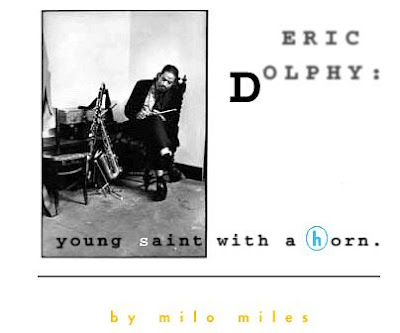
ERIC DOLPHY

Eric Allan Dolphy (June 20, 1928 – June 29, 1964) was an American jazz alto saxophonist, flautist, and bass clarinetist.

Download Music!:  Eric Dolphy-Les; Eric Dolphy-Out To Lunch; Eric Dolphy-Stormy Weather

Dolphy was one of several groundbreaking jazz alto players to rise to prominence in the 1960s. He was also the first important bass clarinet soloist in jazz, and among the earliest significant flute soloists.

His improvisational style was characterized by the use of wide intervals based largely on the twelve tone scale, in addition to using an array of extended techniques to reproduce human- and animal-like effects which almost literally made his instruments speak. Although Dolphy's work is sometimes classified as free jazz, his compositions and solos had a logic uncharacteristic of many other free jazz musicians of the day; even as such, he was considered an avant-garde improviser. In the years after his death, his music was described as being "too out to be in and too in to be out."

Dolphy posthumously became an inductee of the Down Beat Jazz Hall of Fame in 1964.

Biography

Early life


Dolphy was born in Los Angeles and was educated at Los Angeles City College. He performed locally for several years, most notably as a member of bebop big bands led by Gerald Wilson and Roy Porter. On early recordings, he occasionally played soprano clarinet and baritone saxophone, as well as his main instrument, the alto saxophone. Dolphy finally had his big break as a member of Chico Hamilton's quintet. With the group he became known to a wider audience and was able to tour extensively through 1959, when he parted ways with Hamilton and moved to New York City.

Early partnerships

Coltrane had gained an audience and critical notice with Miles Davis's quintet. Although Coltrane's quintets with Dolphy (including the Village Vanguard and Africa/Brass sessions) are now legendary, they provoked Down Beat magazine to brand Coltrane and Dolphy's music as 'anti-jazz'. Coltrane later said of this criticism: "they made it appear that we didn't even know the first thing about music (...) it hurt me to see [Dolphy] get hurt in this thing."

The initial release of Coltrane's stay at the Vanguard selected three tracks, only one of which featured Dolphy. After being issued haphazardly over the next 30 years, a comprehensive box set featuring all of the recorded music from the Vanguard was released by Impulse! in 1997. The Complete 1961 Village Vanguard Recordings carried over 15 tracks featuring Dolphy on alto saxophone and bass clarinet, adding a new dimension to these already classic recordings. A later Pablo box set from Coltrane's European tours of the early 1960s collected more recordings with Dolphy for the buying public.

During this period, Dolphy also played in a number of challenging settings, notably in key recordings by Ornette Coleman (Free Jazz: A Collective Improvisation), arranger Oliver Nelson (The Blues and the Abstract Truth and Straight Ahead) and George Russell (Ezz-thetics), but also with Gunther Schuller, Max Roach and Abbey Lincoln, multi-instrumentalist Ken McIntyre, and bassist Ron Carter among others.

As a leader
 
Dolphy's recording career as a leader began with the Prestige label. His association with the label spanned across 13 albums recorded from April 1960 to September 1961, though he was not the leader for all of the sessions. Prestige eventually released a 9-CD box set containing all of Dolphy's recorded output for the label.

Dolphy's first two albums as leader were Outward Bound and Out There. The first, more accessible and rooted in the style of bop than some later releases, was recorded at Rudy Van Gelder's studio in New Jersey with hard-bop trumpeter Freddie Hubbard. However the album still offered up challenging performances, which at least partly accounts for the record label's choice to include "out" in the title. Out There is closer to the third stream music which would also form part of Dolphy's legacy, and reminiscent also of the instrumentation of the Hamilton group with Ron Carter on cello and Dolphy on bass clarinet, clarinet and flute as well as saxophones.

Far Cry was also recorded for Prestige in 1960 and represented his first pairing with another important partnership, trumpeter Booker Little, a like-minded spirit with whom he would go on to make a set of legendary live recordings at the Five Spot in New York before Little's tragic death at the age of 23.

Dolphy would record several unaccompanied cuts on saxophone, which at the time had been done only by Coleman Hawkins and Sonny Rollins before him. The album Far Cry contains one of his more memorable performances on the Gross-Lawrence standard "Tenderly" on alto saxophone, but it was his subsequent tour of Europe that quickly set high standards for solo performance with his exhilarating bass clarinet renditions of Billie Holiday's "God Bless The Child". Numerous recordings were made of live performances by Dolphy on this tour, in Copenhagen, Uppsala and other cities, and these have been issued by many sometimes dubious record labels, drifting in and out of print ever since.

20th century classical music also played a significant role in Dolphy's musical career. He performed Edgard Varèse's Density 21.5 for solo flute at the Ojai Music Festival in 1962 and participated in Gunther Schuller's Third Stream efforts of the 1960s.

In July 1963, Dolphy and producer Alan Douglas arranged recording sessions for which his sidemen were among the leading emerging musicians of the day. The results were his Iron Man and Conversations LPs. Around this time Dolphy's pianist was occasionally the young Herbie Hancock, this group was recorded at the Illinois Concert and others.

In 1964, Dolphy signed with Blue Note Records and recorded Out to Lunch! with Freddie Hubbard, Bobby Hutcherson, Richard Davis and Tony Williams. This album was deeply rooted in the avant garde, and Dolphy's solos are as dissonant and unpredictable as anything he ever recorded. Out to Lunch, his last major studio recording, is often regarded not only as Dolphy's finest album, but also as one of the greatest jazz recordings ever made.

His final months (1964)

After Out to Lunch! and an appearance as a sideman on Andrew Hill's Point of Departure, Dolphy left to tour Europe with Charles Mingus' sextet in early 1964. From there he intended to settle in Europe with his fiancée, who was working on the ballet scene in Paris. The Mingus band for this tour is recorded on the Cornell 1964 album and is one of Mingus' strongest line-ups, including Dolphy and pianist Jaki Byard. After leaving Mingus, he performed with and recorded a few sides with various European bands, including the mis-named Last Date with Misha Mengelberg and Han Bennink, and was preparing to join Albert Ayler for a recording.

The liner notes to the Complete Prestige Recordings say that on June 28, 1964 Dolphy "collapsed in his hotel room in Berlin and when brought to the hospital he was diagnosed as being in a diabetic coma. After being administered a shot of insulin (apparently a type stronger than what was then available in the US) he lapsed into insulin shock and died." A later video documentary disputes this, saying Dolphy collapsed on stage in Berlin and was brought to a hospital. The attending hospital physicians had no idea that Dolphy was a diabetic and thought that he, like so many other jazz musicians, had overdosed on drugs, so he was left in a hospital bed until the drugs had run their course.

Dolphy died on June 29, 1964 in a diabetic coma, leaving a short but tremendous legacy in the jazz world. He was quickly honored with his induction into the Down Beat magazine Hall of Fame in 1964. Coltrane paid tribute to Dolphy in an interview: "Whatever I'd say would be an understatement. I can only say my life was made much better by knowing him. He was one of the greatest people I've ever known, as a man, a friend, and a musician." Dolphy's mother, Sadie, who had fond memories of her son practicing in the studio by her house, gave instruments that Dolphy had bought in France but never played to Coltrane, who subsequently played the flute and bass clarinet on several albums before his own death in 1967. Dolphy was engaged to be married to Joyce Mordecai, a classically-trained dancer.

Influence

Dolphy's musical presence was hugely influential to a who's who of young jazz musicians who would become legends in their own right. Dolphy worked intermittently with Ron Carter and Freddie Hubbard throughout his career, and in later years he hired Herbie Hancock, Bobby Hutcherson and Woody Shaw at various times to work in his live and studio bands. Out to Lunch! featured yet another young lion who had just begun working with Dolphy in drummer Tony Williams, just as his participation on the Point of Departure session brought his influence into contact with up and coming tenor man Joe Henderson.

Carter, Hancock and Williams would go on to become one of the quintessential rhythm sections of the decade, both together on their own albums and as the backbone of the second great quintet of Miles Davis. This part of the second great quintet is an ironic footnote for Davis, who was not fond of Dolphy's music yet absorbed a rhythm section who had all worked under Dolphy and created a band whose brand of "out" was unsurprisingly very similar to Dolphy's.

In addition, his work with jazz and rock producer Alan Douglas allowed Dolphy's style to posthumously spread to musicians in the jazz fusion and Rock environments, most notably with artists John McLaughlin and Jimi Hendrix. Frank Zappa, an eclectic performer who drew some of his inspiration from jazz music, paid tribute to Dolphy's style in the instrumental "The Eric Dolphy Memorial Barbecue" (on the 1970 album Weasels Ripped My Flesh).

---------------

Jazz needs Eric Dolphy more than ever. A virtuoso on saxophone, clarinet and flute, his work bridges the two sides of a debate that dogs jazz fans and performers today. To oversimplify, the neoconservatives argue that jazz must be profoundly grounded in tradition, that new developments are little more than a gloss, and that history stops with Miles Davis and modal jazz in the middle '60s, with bare whispers of Ornette Coleman and nothing from swingless radicals like Cecil Taylor. The rebels (most now older than the neocons) counter that jazz loses its essence by going backward, that the titans revered by the neocons were fearless innovators, and that the whole reactionary movement reduces jazz to a museum music with a self-righteous fence around it. Dolphy could have listened to both sides, picked up his horn, and showed the way out in a dozen choruses. But he died in 1964, barely 36, struck down by complications stemming from undiagnosed diabetes. 

Dolphy, who studied classical flute with Elise Moennig (and brought the instrument into jazz more forcefully than anyone before him) and founded the bass clarinet as an improvising horn, flourished in a jazz scene far more turbulent and riven than today's. A Los Angeles native who honed his chops for years on the local scene, he gained national attention as a member of the Chico Hamilton band, and went out on his own at the end of 1959. By then, Taylor and Coleman had already dropped the bombshells that ignited free jazz, and the response to their challenge would dominate the next 10 years of the music. Dolphy began with a blast of creativity: he would never record as much for the rest of his life as he did in 1960-61. Many key parts of those sessions are gathered together for the first time on the 9-CD box "Eric Dolphy: The Complete Prestige Recordings" (Milestone). 

No acquaintance ever had a bad word to say about Eric Dolphy the person. All describe him as calm, kind, witty, humble and introspective. The mercurial bassist and band leader Charles Mingus, a harsh judge of character, called Dolphy "a saint." He needed the internal fortitude to withstand the resistance his work met not only with the public but with more traditional jazz players. Financially strapped his whole career, Dolphy had to scramble for gigs. He never touched drugs or alcohol. His only addiction was constant practicing -- in the bathroom between sets, next to the record player at parties. 

The sound-blip version of Dolphy is that he was freer than John Coltrane but more traditional than Ornette Coleman. He met both men in the middle '50s and later played crucial dates with them, as well. But Dolphy's technique and soul stand apart.

Source: http://www.salon.com/05/reviews/dolphy.html

---------------

Discography

As leader

Hot & Cool Latin (1959)
Wherever I Go (1959)
Status (1960)
Dash One (1960)
Outward Bound (1960)
Here and There (1960)
Looking Ahead (1960)
Fire Waltz (1960)
Other Aspects (1960)
Out There (1960)
The Caribe with the Latin Jazz Quintet (1960)
Candid Dolphy (1960)
Magic (1960)
Far Cry (1960)
Eric Dolphy (1960)
The Quest (1961)
The Great Concert of Eric Dolphy [live] (1961)
Live! at the Five Spot, Vol. 1 (1961) with Mal Waldron and Booker Little
Live! at the Five Spot, Vol. 2 (1961)
* Eric Dolphy and Booker Little Memorial Album (1961) (more from the Five Spot)
Latin Jazz Quintet (1961)
Berlin Concerts [live] (1962)
Eric Dolphy in Europe, Vol. 1 [live] (1961)
Eric Dolphy in Europe, Vol. 2 (1961)
Eric Dolphy in Europe, Vol. 3 (1961)
Copenhagen Concert [live] (1961)
Softly, As in a Morning Sunrise (1961)
Quartet 1961 (1961)
Vintage Dolphy (1962)
Eric Dolphy Quintet featuring Herbie Hancock: Complete Recordings (1962)
Conversations (1963) (also known as Jitterbug Waltz)
Iron Man (1963)
The Illinois Concert [live] (1963)
Out to Lunch! (1964)
Last Date (1964)
Naima (1964)
Unrealized Tapes (1964)

As sideman

Chico Hamilton
Chico Hamilton Quintet with Strings Attached (1958)
The Original Ellington Suite (1958)
Chico Hamilton - Gongs East! (1958)
That Hamilton Man (1959)(also released as Truth

Charles Mingus
Pre-Bird [aka Mingus Revisited] (1960)
Charles Mingus Presents Charles Mingus (1960)
Mingus at Antibes (1960)
Mingus Mingus Mingus Mingus Mingus (1963)
Town Hall Concert (1964)
The Great Concert of Charles Mingus (1964)
Revenge! (1964)
Charles Mingus Sextet with Eric Dolphy: Cornell 1964 (1964)

Ornette Coleman
Free Jazz: A Collective Improvisation (1960)

Oliver Nelson
Screamin' the Blues (1960)
The Blues and the Abstract Truth (1961)
Straight Ahead (1961)

John Coltrane
Olé Coltrane (1961)
Africa/Brass (1961)
Live! at the Village Vanguard (1961)
Impressions (One Track, "India") (1963)

Makanda Ken McIntyre
Looking Ahead (1960)

Booker Little
Out Front (1960)

George Russell
Ezz-thetics (1961)

Max Roach
Percussion Bitter Sweet (1961)

Andrew Hill
Point of Departure (1964)

John Lewis
The Sextet of Orchestra U.S.A. (1964)
John Lewis Presents Jazz Abstractions (1960)

Readmore...

JAZZ, STRUGGLES TO SURVIVE

More often than not, the American legacy in this country is perceived negatively; it is invariably associated with capitalism. 

However, there is one legacy that has remained and needs to be nurtured: Jazz. 

According to www.wartajazz.com, in its interview with Sudibyo Pr., an architect and jazz aficionado, the history of jazz in Indonesia dates back to 1922, when Dutch colonialists brought jazz records here. 

There was also a Dutch saxophone player who came to this country after staying for a long time in the United States, and formed a jazz band here with his fellow Dutchmen. 

In that early period of jazz here, the music was played mostly by Dutch Indonesians, with very few locals tuned into it. Although reports stated that the first Indonesian jazz musician was an Acehnese. 

Aside from the Dutch, sources said that the jazz waves were also brought in by Filipino musicians who came to Jakarta from 1925 to 1927. Some of their descendants even still live in Bandung, according to Sudibyo, namely Benny Pablo, Benny Corda and Sambayong, among others. 

Jazz in the early years here was centered in Jakarta; Bandung and Bogor in West Java; Surabaya in East Java and Makassar in South Sulawesi. The music at that time was more of an entertainment, rather than an art form as it is perceived today. 

Jazz musicians comprised of military officers, as musical instruments were still rare, who played for the Dutch and upper-class Indonesians. 

A little note on the lack of instruments, only jazz bands at that time used drums because they were expensive. Therefore, drums were equated with jazz and people called a band a "jazz band" when it had a set of drums. 

The first Indonesian jazz bands probably comprised of army cadets living in Yogyakarta circa 1948. Some of them then moved to Jakarta, and played Hawaiian pop and then later on light jazz like Manhattan Transfer. 

The musicians who rose in popularity at that time were Boetje Pesolima, Doddy Hughes, Dick Van Der Capellen and Tjok Sin Soe. There was also Sigar Lucky Brothers, who moved to California for better prospects, pianist Nick Mamahit, Iskandar (father of singer Diah Iskandar) and Etto Lattumeten who established a band called Dixieland. 

At the end of the 1940s, there was an excellent pianist Marihut Hutabarat referred to as the Indonesian George Shearing, who died young in an accident. 

Afterward there was the generation of Paul Hutabarat, Eddie Gatot, Bill Saragih and also Bing Slamet. 

Bing Slamet, who took his first name from his idol Bing Crosby, was better known as a comedian. But he actually was an excellent jazz vocalist and guitarist. 

And then, of course, there were the late Jack Lesmana and (still going strong) Bubi Chen. After his first performance at the Berlin Jazz Festival in 1967, Bubi was highly praised and even called by Downbeat magazine as "The best in Asia" and even "One of the best in the world." 

Jazz continued to develop in Indonesia, albeit slowly. 

The 1980s was probably the last decade when jazz reigned supreme in this country, with jazz bands like Karimata, and Krakatau (albeit more fusion), with jazz vocalists like Ermy Kulit and Rien Djamain excelling in the Top 40 charts. 

It has not been a pretty picture since then, with jazz remaining a very segmented genre. 

Jack's son Indra Lesmana, who was hailed as a jazz whiz-kid, even had (and still has) to stray into pop to survive, and so do other musicians. 

Pianist Chandra Darusman of Karimata became an activist for intellectual property rights, while Krakatau has veered heavily into ethnic music nowadays. 

Jazz events like Jak Jazz went kaput, while Jazz Goes To Campus, the biggest and the longest running jazz festival, became stagnant. 

Sudibyo said that the lack of appreciation for jazz is natural as even in the United States, jazz was abandoned in its early days. Besides, jazz is not that easy to digest, which is a bit ironic because back in the 1930s, jazz was an easy listening music and easy to dance to. 

After the 1960s, however, it got more and more complicated so that young people were reluctant to listen to it. 

Despite the limited audience and slow regeneration, however, jazz in this country continues to survive. Indra Lesmana still manages to produce jazz albums with his band Reborn, for instance, as well as noted musician Tjut Njak Deviana Daudsjah who with her music school Institut Musik Daya, strived to produce jazz musicians. 

There are also young names like Nial Djuliarso or light jazz band Sova, as well as young vocalist Andien. 

Once a year, jazz aficionados can gather at the Jazz Goes To Campus (this year it will hit its 28th year), despite its shortcomings. 

Early this year, the Java Jazz festival was held, comprising more than a dozen foreign and local musicians and attracted a huge crowd. Hopefully, this is a sign of a better future and appreciation for the local jazz scene.

Source: The Jakarta Post

Readmore...

BUBI CHEN

Bubi Chen is one of Indonesia’ best-known jazz musicians and has an outstanding international reputation. Bubi Chen’s career as a jazz pianist has spanned over four decades through which he has recorded an album in Los Angeles with world’s class musicians John Heard and Albert “Tootie” Heath and several solo albums recorded in Indonesia and Singapore. At Berlin Jazz Festival in 1967 he played with Tony Scott and Phylly Joe Jones. In addition he also played and recorded numerous album with Singapore’ greatest jazz pianist Jeremy Montero.

The virtuoso performer was born in 1938 in Surabaya the second largest city in Indonesia where he spends most of his time. He grew up in a musician household, where his older brothers Teddy and Jopie were both known as respected jazz musicians during 60s and 70s. In fact, Bubi and Jopie were part of the highly acclaimed Indonesian All Stars who made history in performing at Berlin Jazz Festival in 1967. It was the first Indonesian jazz band performed at an International jazz festival. Indonesian All Stars comprise of Kiboud Maulana (guitar), Jack Lesmana (guitar), Benny Mustafa (drums), Maryono (sax), Jopie Chen (bass) and Bubi Chen (piano). Their own composition, “Janger Bali” that blended ethnic music of Bali and straight ahead jazz, has received outstanding review from many jazz observers.

In 1968, Bubi was voted in the DownBeat magazine reader polls as one of 5 best jazz pianists in the World and the best in Asia. He is the first Asian jazz musician ever voted in reader polls of the prestigious jazz magazine. Together with the late Maryono (sax), Perry Pattiselano (bass), Benny Mustafa (drums) he revived Indonesian All Stars and performed at the North Sea Jazz Festival in 1992. His solo album “Virtuoso” was released in 1995 with the support of Belinda Moody (bass) and Louis Soliano (drum).

Readmore...

Wednesday, March 4, 2009

MATTHEW GARRISON

Matt's Bio

Matthew Garrison was born June 2, 1970 in New York. Here he spent the first eight years of his life immersed in a community of musicians, dancers, visual artists and poets. After the death of his father Jimmy Garrison (John Coltrane's bassist), his family relocated to Rome, Italy where he began to study piano and bass guitar. In 1988 Matthew returned to the United States and lived with his godfather Jack Dejohnette for two years. Here he studied intensively with both Dejohnette and bassist Dave Holland. In 1989 Matthew received a full scholarship to attend Berklee College of Music in Boston. Here he began his professional career with the likes of Gary Burton, Bob Moses, Betty Carter, Mike Gibbs and Lyle Mays to mention a few. Matthew moved to Brooklyn, New York in 1994 and has performed and recorded with artists such as Herbie Hancock, Joe Zawinul, Joni Mitchell, Steve Coleman, Pat Metheny, John Mclaughlin, The Gil Evans Orchestra, John Scofield, Chaka Khan and many others.

---------------

Matthew Garrison is an American jazz bassist.

Garrison has worked with artists such as Herbie Hancock, John McLaughlin, Chaka Khan, Joe Zawinul, the Saturday Night Live Band, John Scofield, Paul Simon and Joni Mitchell. He is the son of Jimmy Garrison, John Coltrane's bass player, and he is noted for playing his signature series Fodera bass.

Garrison also recognized for having created and developed a pizzicato technique which uses four fingers. He founded his own recording label and production company in 2000 called GarrisonJazz Productions, through which he has released two CDs and a live performance DVD.

---------------

Matthew Garrison was born June 2, 1970 in New York. Here he spent the first eight years of his life immersed in a community of musicians, dancers, visual artists and poets. After the death of his father Jimmy Garrison (John Coltrane’s bassist), his family relocated to Rome, Italy where he began to study piano and bass guitar. In 1988 Matthew returned to the United States and lived with his godfather Jack Dejohnette for two years. Here he studied intensively with both Dejohnette and bassist Dave Holland.

In 1989 Matthew received a full scholarship to attend Berklee College of Music in Boston. Here he began his professional career with the likes of Gary Burton, Bob Moses, Betty Carter, Mike Gibbs and Lyle Mays to mention a few. Matthew moved to Brooklyn, New York in 1994 and has performed and recorded with artists such as Herbie Hancock, Joe Zawinul, Meshell Ndege Ocello, Joni Mitchell, Jack Dejohnette, Steve Coleman, Cassandra Wilson, Wallace Roney, Pat Metheny, Geri Allen, Gary Thomas, John Mclaughlin, The Gil Evans Orchestra, Tito Puente, John Scofield, Chaka Khan, Michael Brecker, Randy Brecker, Mike Stern, The Saturday Night Live Band and many others.

In 1998 Matthew founded GarrisonJazz Productions through which he currently Produces, Promotes and Markets his music. The latest projects are “SHAPESHIFTER” and “MATT GARRISON LIVE”. Three new projects are slated for a 2008 release.

---------------

Matt Garrison 
Shapeshifter 
GarrisonJazz Productions 
2004 


In Y2K, Bass Player Magazine pronounced Matthew Garrison's debut as having "raised the bar" for electric bass players (in an article by Chris Jisi, who recently wrote the book on modern electric bass). What next, then? Fitting in this Olympic year, Garrison steps back from the bar, raises it a foot, challenges himself to make it over and succeeds on every level, turning in the greatest solo record by an electric bassist in the post-Jaco era.

Not merely a great electric bass player, he actually plays the instrument at the margins of human capability. Having captured the imaginations of the world's electric bass players and enthusiasts, he's set his sights on the ears and minds of the global audience for adventurous music. Importantly, he does so without taking virtuoso technique and mind-boggling facility off the table. Compositionally, he's retained the far eastern Indian flavor of his debut, while adding a brave new dose of electronica to the mix. There's a new emphasis on consistently changing up the tone and texture of the bass, in both ensemble and solo functions. The numbers of supporting cast and their roles have been narrowed, with Garrison taking on more of the burden of soundscape creation via computer-aided studio expertise. Finally, he's perfected the art of creating hook-laden melodic snippets, and placing them in various spots in the mix relative to countermelodies, counter-rhythms and counter-bass lines, none of which function counter to any other components.

For example, "Symbiosis," opens the set with a melodic fragment of eastern origin, sung by Sabina Sciubba , meeting percussively strummed acoustic guitar (also by Garrison), before being supplanted by slamming, power-chord style, distorted bass, in an ascending four-part progression of three notes each. A melody line reemerges, this time sung by the bass, chiming, sitar-like, with notes in the high register. A deep bass synth break recontextualizes the opening, vocal melody, as new synth pads offset the complementary descending bass line. Unison guitar and bass then voice a different, equally hummable melodic fragment over a loping folk-fretless line. This sets up a distorted, backward-looped bass solo, gorgeously steeped in expressive psychedelia. As the backward effect is removed, Garrison's trademarked shards, pieces of chords drawn from the scale-of-the-moment's harmony, replace it, followed by effortless linear melodicism, building to a phenomenal ripping sequence of his own device, recalling Jimi more than Jaco.

"Three Tree" is a duet with Arto Tuncboyacian on percussion. Any bassist who throws down this fluidly and virtuosically in the company of a sole percussionist is bound to get comparison to "Donna Lee," Jaco's celebrated throwing of the gauntlet with Don Alias. This one's a bossa improv of epic proportion. It's all there, the gorgeous chord voicings, the harmonic outline, the flat-out speed and impossible articulation of the right hand, the matching up of the left with the complete knowledge and instantaneous availability of the jazz vocabulary. But this is not an instrumentalist playing some famous standard at a breakneck pace. It's a relaxed performance, a spontaneous improvisation that right away imparts the feeling that Garrison could toss off any number of takes on this vibe, each of them as great as the last, yet different - what jazz, and virtuosity, are all about.

"Life Burning" combines the love for all things Indian with all things Squarepusher-drill'n'bass meets drilling bass for some Punjabi takeout. Note the Indian Massive-that's the real , Indian, massive bass sound punctuated by some kind of Hindu chanting - or is that cheerleading? Slamming it all against a very straight snare and hi-hat beat somehow propels it to the energy quotient to the next level, as do the wordless vocals by Tuncboyacian. The electronica sequence returns before another monster solo blows it all up, crossing up "Flight of the Bumblebee" pyrotechnics with ragaisms aided by pull-offs and trills, stopping for a hit of funky blues. The linear excursions that follow are decidedly not of the bop vocabulary; rare is the player on any instrument that draws lines so clearly from harmonic point to point that sit so well on their axe of choice. 

“This release represents a modern-day passing of the torch. Compelling that Garrison's father played acoustic bass on what are indisputably jazz's greatest recordings - now comes Matthew demonstrating nothing less than he's the world's greatest electric bass guitarist”

"I Can See You Now" slams enormous rock riffing up against Gnawan trance, with ankle-bracelet bells evoking Krishnas brandishing Strats. Big air moves under fretless skies, propelled forward by a Pastourian pump never executed so cleanly. Then screams, samples of massive human call and response added by Scott Kinsey , accelerate us into his scintillating Rhodes solo, which somehow injects a dose of funk into this electro-world groove. Note that Kinsey, perhaps in compensation for his inhuman chops quotient, has now established himself as an innovator for incorporating the human element, in the form of sampled vocals—pitched, unpitched, sung, spoken or screamed—into his custom-programmed sonic voice.

"Mirror Image" and "Changing Paths," both completely performed by Garrison, have a more epic, world flavor. The "Mirror" reflects West Africa or Algiers perhaps, a crossover incorporating incantations on high, with Matt on vocals. Like many cutting-edge instrumentalists, Garrison reveals he's a surprisingly gifted vocalist as well. No solos here, just pure melody and atmospherics combined in heartrending ways. "Changing Paths" shows the influence of Sting or Peter Gabriel in terms of mystically elegant soundscape, a somber frame drum march setting up haunting harmony, this one features his eerie, highly proficient steel-string guitar to supplement his tear-drenched bass sweep, supplemented by a distant scat vocal. More experiments in this direction, please.


"Exchange" builds fiercely in electronic fashion but soon adds beauty in the form of Icelandic vocalizing by Veronika Garrison over two-note chords voicing the melody on bass. A passage then ensues full of wondrous digitized glossolalia, a combination of backward bass triggering Veronika's sampled vocal, creating the effect of a sci-fi enchantress enticing explorers toward her embrace, abetted by some kind of otherworldly sound-producing device. As Kinsey enters the fray the song delves into the realm of Josef Zawinul, employing the familiar accordion and harmonica-like sounds, an ethnic, folk-like wordless vocal and a bouncy, rubbery bass line. Kinsey has seriously studied Zawinul's improvisational and compositional styles, as well as the finer elements of his sound architecture, and Garrison is a former employee, so this section is all you can imagine. The bass solo begins gently, drenched in linear lyricism, with a touch of distortion, interrupted by electronic stutters and stops. A simple backbeat is employed to support complexity as the digital stuttering effect continues, punctuating and puncturing the solo, a multitude of ideas and techniques colliding to create an ultra-modern, yet very musical spot. This type of diginoise effect is usually applied to breakbeats or other sections in the work of noted digital auteurs, but this sets the precedent for seamless incorporation into an instrumental solo, which helps makes "Exchange" another compositional and soloing tour-de-force.

"Turn Around," concludes with layer upon layer: Garrison's bass, Jim Beard 's synth, and Adam Rogers ' banjo and cavaquino, until a melody line is doubled on top by the vocals of Matt's singer-sister Joy and the harmonica of Gregoire Maret. Two minutes in, this shimmering cloud rains a liquid bass solo, a "rewind moment " that in 45 seconds, simply transcends the work of the generation of bassists that made Garrison possible-not only in the harmonic sense, standing as a mini-composition, but in that it exudes electrifying emotion, molten with the passion and joy radiating from its architect. Rogers, with clean electric tone and Beard, employing synth-sustained squeezebox, follow with equally prodigiously executed spots bursting with poignant content-rare does this muscular an instrumental display, by all the players, convey such ecstatic exhilaration.

This release represents a modern-day passing of the torch. Compelling that Garrison's father played acoustic bass on what are indisputably jazz's greatest recordings - now comes Matthew demonstrating nothing less than he's the world's greatest electric bass guitarist (reality check: if there are other guys capable of playing this stuff so absolutely freakishly, none are demonstrating it on recordings). The funny thing is, this is way not the intent here. 

Sure, Garrison's debut, in spots, was attempting to show all he could do, but now it's all about the composition, the composite, the trip and the vibe. The fact that he's taken the record label out of the equation has surely aided him in feeling his way into his style in the most comfortable, organic way. Simply put, letting go has allowed him to craft one for the ages. It's a benchmark for the type of electronica that is separate from trend-jumping jazztronica hybrids and for music incorporating world influences that is separate from the "world music" bin. Most importantly, it should be held up as a shining example for the type of electric jazz-fusion of musics and styles that is separate from the technocratic, chops-driven excesses and exercises of "fusion" 's past. 

Recently, vocal jazz has been perceived to have returned to favor with artists like Norah and Jamie, the piano trio reworked by the Bad Plus and EST and the avant-garde invigorated by the talent stable locked in the Blue Series' electronica laboratory. But in terms of marketability, resonance and relevance, electric jazz remains at a crisis point—in need of a shot in the arm—a reinvention triggering a comeback of sorts. With a release of this magnitude, it's alluring to poetically posit that Garrison, a scion of jazz's fabled past, yet an outsider in the current state of the jazz business, should be the one fated to spearhead that transformation.


An up-to-the-moment interview can be found here . 

Tracks: 1) Symbiosis, 2) Unity, 3) I Told Ya So, 4) Three Tree, 5) I Can See You Now, 6) ZZAJ 5.1, 7) Life Burning, 8) Mirror Image, 9) Exchange, 10) Changing Paths, 11)Turn Around 

Personnel: Sabina Sciubba:vocals (1,2,3), Gregoire Maret:harmonica (1,2,11), Arto Tuncboyacian:percussion (1,2,4,7, 9), vocals (7), Jim Beard: keyboards (1,2,11), Jojo Mayer: drums (2,7), Elliot Mason: bass trumpet (5), Scott Kinsey: keyboards (5,9), Will Calhoun: Wusuli (5), Veronika Garrison: vocals (7,9), noise (5), Joy Garrison: vocals (11), Adam Rogers, guitar (11), Warren Brown:mixing, mastering, sound design (all), John Arnold: drums (11), Matthew Garrison: bass (all), programming (1-3, 5-11), guitar (1,3,10), keyboards (2,3,7,9,11), vocals (5,9,10,11)

---------------

MATT GARRISON: NO LIMITS, NO FEAR
By John Pritchard


I first heard Matt Garrison's amazing bass playing on Joe Zawinul's "My People" in 1996 and John McLaughlin's "The Heart of Things" in 1997. Tracing back Matt's roots to his legendary dad, the late Jimmy Garrison (bassist with John Coltrane), it is cool to see a son not only carrying the jazz bass torch of his father, but also blazing new musical trails with incredible five string chordal bass music of his own!!! Check out the video clips on the left to see what I mean.

In 1998 Matt took the bull by the horns and founded GarrisonJazz Productionsto record, produce and market his music. In 2001, his self titled solo debut CD "Matthew Garrison" received critical acclaim immediately and featured guitarists David Gilmore and Adam Rogers, keyboardist Scott Kinsey, drummers Gene Lake and Ben Perowsky, percussionist Arto Tuncboyacian, saxaphonist Dave Binney, along with Pete Rende on accordion and Amit Chaterjeeon on sitar. Many of the tracks are featured on Matt's Live DVD with much of the same lineup with additional talent such as Jim Beard on keyboards, JoJo Mayer on drums, and singer Sabina Sciubba. 

In 2002, Matt toured with Herbie Hancock on the "Future 2 Future" tour and can be seen jammin on the "Future 2 Future" DVD Herbie produced from a gig at the Knitting Factory in LA.

In March of 2003, Matt began his most adventurous album, "Shapeshifter," which was released simultaneously with his Live DVD this past August 2004. The album features guitarist Adam Rogers, keyboardists Jim Beard and Scott Kinsey, vocalists Sabina Sciubba, Joy Garrison and Veronika Garrison, drummer JoJo Mayer, percussionist Arto Tuncboyacian, Elliot Mason on Bass Trumpet, Gregoire Maret on harmonica, and a special appearance by Will Calhoun on Wusuli.

What I love about this album is the fact that Matt has no fear of mixing in electronic programming with more familiar composition styles in the world fusion, instrumental, vein. He is so much more than "one of the world's best bass players." The 10th tune, "Changing Paths" blew me away and features Matt playing all the tracks with some phenomenal acoustic guitar to boot! While all the music showcases superb musicianship throughout, it is Matt's tasty computer-driven morsels that surprise and engage my curious ear (check out "I Told Ya So" and "Mirror Image" mp3's below). Matt is simply not afraid to explore the boundaries he 'shapeshifts' into with the wide range of musicians he plays with, and the original music he composes and performs. 

As yet further proof of his fearlessness, the 9th song, "Exchange," (an unquestionable "Bjork" tribute song) is an absolute delight in that it features his wife Veronica's magical singing. It is produced with a perfectly processed vocal effect. The end result creates an ethereal, almost spiritual dimension that is certainly better sounding than anything found on commercial radio! No smooth jazz, retro-Cher/top 40 vibe here... just simply great music, period. Check out this poetic excerpt from the "Exchange" lyrics (translated from Icelandic of course):

"The stars fall into my palms
I put them into me where you are
I rise up against the sky
Open and ready to receive the world."

This is what I mean by No Fear, No Limits...you don't expect it... it is about being an artist and going for it...and he does it with confidence and grace. 

Matt is fluent in so many musical styles. He has no problem being both an excellent band leader and a soloist prominently showcasing his innovative bass playing up close and in your face (but not like Jaco on the ego end, or Marcus Miller on the "not quite enough bass soloing" side... just the right amount). While I suspect that feeling of musical "Unity" is what it is all about for Matt Garrison the band leader (listen below), his modern electronic ventures into new and forbidden worlds of jazz is what it's really about for his artistic spirit ...and, damn, what a soulful, together, tight, unified sound he delivers... so happy and so badass five string strummin free!

Source: http://pritchardschool.com/jazzrock/interviews-matt.html

---------------

Matt Garrison Interview 
with Jazz-Rock.com - DECEMBER 9, 2004 


1. Congratulations on your LIVE DVD/CD! It is quite excellent. How did it come about? the music? the video? the players? 

Thanks. The DVD was an idea that I had floating around for a couple of years and it finally came to fruition when I met Pete Teresi and Carolina Saavedra from Pefaur Productions (www.pefaurproductions.com). I originally wanted to just make a live recording but of course once I had the option of filming the recording session it all just came in to place. The music is primarily from my first CD. We actually recorded even more material that didn't make it to the final output but that's for a reissue with bonus tracks later. All the musicians except for Jojo Mayer were on my first recording and that's who I wanted to feature on the live DVD. 

2. How about your ShapeShifter CD? How did it come together? What was the inspiration? 

The title itself is kind of a self description. I feel I have become somewhat of a mutating character that takes on the shape that is necessary for the type of music work at hand. It's also a statement of independence of thought. Having started my own record label has given me a sense of hope, pride and strength when composing music in the sense that I have no one to answer to when I have an idea to layout. The project was constructed over a period of 2 years and just took on a life of it's own once I got to about the 4th composition. Everything just rolled on naturally and as new influences became available they appeared in the music immediately. Shapeshifter was really inspired by my first record, Squarepusher, Bjork and Sergei Prokofiev's music. 

3. How do you approach composition and live improv with such original ideas? 

I guess I just don't pay attention to what is traditionally or technically considered jazz. I just do what I like and dare to make my own decisions concerning sound, style, approach, concepts... I hate limitations and evaluations. That's not my field. The worst thing is that those limitations and fears usually come from other musicians in my same field. Really some sad shit.... 

4. What are some golden moments with all the great musicians you have played with? 

The golden moments have been just knowing and feeling that while you're performing with these geniuses you share a common bond, even if it's just for a split second, that we're all moving in the same direction. I love it when I'm welcomed into a space to share the experience of music, and over the years I've been blessed to be welcomed into spaces of pure musical bliss. I'm very thankful to all of them... 

5. What's going on with GJP and what is your vision for your future? 

Well first I'd like to thank all of the incredible people that took the "plunge" and actually purchased my 2 latest projects "Shapeshifter" and "Matt Garrison Live". I posted a notice on my site prior to the release of them both stating that file swapping and CD ripping were only going to make my future productions impossible and that I needed folks to seriously consider supporting my label rather than opposing it. In the past 3 months I've sold more CD's and DVD's than ever before and I cannot possibly thank people enough for their support and respect. We are responsible for our actions and that's the most important reality to understand at the moment. Now that my production war chest is basically full again I'm going to take a breather and decide which project to develop next. Whichever it will be, I will begin that actual work early next year. 

Thanks for having me as a guest on your site. 

- Matt G.

Source: http://pritchardschool.com/jazzrock/interviews-matt.html

---------------

Matthew Garrison Signature

Matthew Garrison was born June 2, 1970 in New York. Here he spent the first eight years of his life immersed in a community of musicians, dancers, visual artists and poets. After the death of his father Jimmy Garrison (John Coltrane’s bassist), his family relocated to Rome, Italy where he began to study piano and bass guitar.

In 1988 Matthew returned to the United States and lived with his godfather Jack Dejohnette for two years. Here he studied intensively with both Dejohnette and bassist Dave Holland.

In 1989 Matthew received a full scholarship to attend Berklee College of Music in Boston. Here he began his professional career with the likes of Gary Burton, Bob Moses, Betty Carter, Mike Gibbs and Lyle Mays to mention a few. Matthew moved to Brooklyn, New York in 1994 and has performed and recorded with artists such as Herbie Hancock, Joe Zawinul, Joni Mitchell, Steve Coleman, Pat Metheny, John Mclaughlin, The Gil Evans Orchestra, John Scofield, Chaka Khan, The Saturday Night Live Band and many others.

In 1998 Matthew founded GarrisonJazz Productions through which he currently Produces, Promotes and Markets his music. The latest projects are “SHAPESHIFTER” and “MATT GARRISON LIVE”. All information concerning these and other releases may be obtained through www.GarrisonJazz.com

In the mid 90's we were approached by Matt in his quest to find a bass to compliment his unique playing style. Initially Matt was attracted to the Imperial bass, however after numerous modifications were made at his request, the Imperial was transformed into a significantly new design. The Matt Garrison Signature model is distinguished by several important features including a 33" scale, ash neck, ebony fingerboard, 26 frets and a finger ramp between the pickups to better facilitate Matt's style of light-touch multi finger style playing. The body made of highly select walnut is light and diminutive providing this bass with an overall warm tone but with a pointed clarity to the notes. The shorter scale and quick respone makes this bass incredibly effortless to play.

---------------

Discography

Pat Metheny – Stone Free (1993
Bob Moses – Time Stood Still (1994)
Nando Lauria – Points of View (1994)
Steve Coleman – The Tao of Mad Phat (1995)
Joe Zawinul – My People (1996)
Steve Coleman – Def Trance Beat (1997)
John McLaughlin – The Heart of Things (1997)
Rocco Zifarelli – Lyndon (1998)
Harry Sokal – Full Circle (1998)
Andy Milne – Forward to Get Back (1998)
Jim Beard – Advocate (1999)
John McLaughlin – The Heart of Things - "Live in Paris" (2000)
Matthew Garrison – Matthew Garrison (2001)
Dennis Chambers – Outbreak (2002)
Herbie Hancock – Future 2 Future Live (2002)
Anders Mogensen, Niclas Knudsen – Anders Mogensen & Niclas Knudsen feat. Matt Garrison (2002)
Revolution Void – Increase the Dosage (2004)
Matthew Garrison – Matt Garrison Live (2004)
Matthew Garrison – Shapeshifter (2004)
World Saxophone Quartet - Experience (2004)
Wallace Roney – Prototype (2004)
Me'shell Ndegeocello – The Spirit Music Jamia: Dance of the Infidel (2005)
Gary Husband – Force Majeure (2005)
Wallace Roney – Mystical (2005)
John McLaughlin – Industrial Zen (2006)
Alex Machacek, Jeff Sipe - "Improvision" (2007)

Readmore...